
Employment, Training and Development, and Labor Practices




Continuously promote equal access to skills development and professional advancement opportunities for 100% of employees at all levels.
Develop Individual Development Plans (IDPs) covering 100% of employees by 2029.
Establish Succession Plans covering 100% of critical C-Level and Director positions by 2029.
Provide employees with an average of at least 26 hours of training per person per year.
Maintain the employment of persons with disabilities at a ratio of at least 1 person with a disability for every 100 employees without disabilities, in accordance with legal requirements.
Training and Human Resource Development
In 2025, the Company achieved a 100% participation rate in skills development and professional advancement opportunities for employees at all levels, in line with its long-term target. This reflects that employees across all levels have equal and comprehensive access to opportunities for capability development.
The Company recorded an average training of 30.37 hours per employee per year exceeding the target of 26 hours per employee per year. This reflects a strong and continuous investment in human capital development. The average training expenditure was THB 6,949 per employee per year.
The Company has implemented a Succession Plan covering 96% of executive-level positions (C-Level and Director), approaching its target of 100% coverage by 2029, to ensure continuity in key leadership succession.
The Company has implemented Individual Development Plans (IDP) covering 25% of employees and is expanding coverage toward the target of 100% by 2029 to ensure systematic, individualized workforce development.
The Company’s human resource development is driven by a data-driven approach through Competency Gap Analysis against the Professional Level framework. This covers key business-critical competencies, including production and quality control, occupational health and safety, environmental management, process engineering, laboratory testing, as well as digital skills and logistics.
Employment and Labor Practices
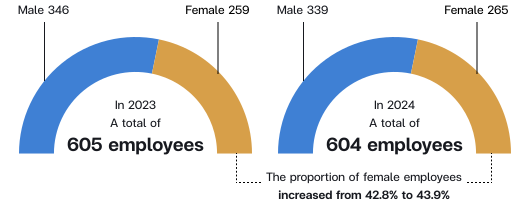
In 2024, the Company had a total of 604 employees (339 male and 265 female), comparable to 605 employees in 2023 (346 male and 259 female). The proportion of female employees increased from 42.8% to 43.9%, reflecting greater gender diversity within the organization.
The Company had 92 new hires in 2024 (increasing from 85 in 2023) and 93 resignations (increasing from 75 in 2023). This data serves as key information for monitoring future employee retention.
The Company employed six persons with disabilities เin compliance with the statutory requirement of a 1:100 ratio of persons with disabilities to employees, and provided training and skills development in accordance with the organization’s development plan.
The Company designs compensation and benefits based on 10 key principles, including fairness and non-discrimination, health and well-being promotion, long-term financial security (provident fund and life insurance), work-life balance, and linkage of benefits to performance outcomes.
The Company operates under its labor social responsibility policy and has established the rights and duties of employers and employees in accordance with Section 17 of the Occupational Safety, Health and Work Environment Act B.E. 2554 (as effective from 1 February 2024). The Company is guided by human rights principles, equality, and non-discrimination, and prohibits forced labor and child labor, while protecting vulnerable workers and preventing sexual harassment in the workplace.
The Company promotes work-life balance through flexible working arrangements, including hybrid working, work from home, and work from anywhere options for positions that do not affect production processes or quality control. These initiatives are complemented by efforts to enhance employee well-being in both physical and mental health aspects.
Challenges and Opportunities
Human resource management, talent development, and labor practices represent both strategic risks and opportunities that directly impact safety standards, production efficiency, competitiveness, and the organization’s sustainable growth. This is particularly critical in the specialty lubricants, chemicals, and logistics businesses, which require specialized expertise and high-level safety standards. The Company therefore conducts a comprehensive analysis of these issues to manage risks while creating value from human capital.
Challenges
The first key challenge is that the Company’s business requires personnel with highly specialized knowledge and skills in production and quality control, occupational health and safety, process engineering, laboratory testing, and logistics management. Developing employees to meet defined competency standards and keep pace with technological change is therefore an ongoing challenge. This is reflected in the current Individual Development Plan (IDP) coverage of 25%, which still needs to be expanded significantly to achieve the target of 100% by 2029.
The second challenge is employee retention. In 2024, the Company recorded 93 resignations, an increase from 75 in 2023, while the overall workforce remained stable at approximately 600 employees. Managing the retention of skilled personnel and strengthening employee engagement have therefore become key priorities. In addition, the nature of operations involving chemicals and specialized machinery makes occupational health and safety management, as well as strict compliance with labor laws and human rights standards, an ongoing and systematic challenge.
Opportunities
In terms of opportunities, structured, data-driven, and competency-based human resource development enables the Company to enhance workforce capabilities in alignment with its business direction. This is evidenced by a 100% training access rate and an average training of 30.37 hours per employee per year, exceeding the target. These achievements reflect the workforce’s readiness to support industrial customer requirements and technological changes, forming a key foundation for competitive advantage.
In addition, establishing career pathways and a Succession Plan covering 96% of executive positions provides an opportunity to ensure leadership continuity and long-term organizational stability. Furthermore, promoting work-life balance, employee well-being, and fair, competitive benefits enhances the Company’s ability to attract and retain specialized talent. Moreover, operations grounded in human rights principles, equality, non-discrimination, and diversity promotion—including compliance with disability employment requirements and an increasing proportion of female employees—strengthen the Company’s reputation and responsiveness to stakeholder expectations for responsible business practices.
Management Approach and Value Creation
Employment and Labor Practices Management Approach
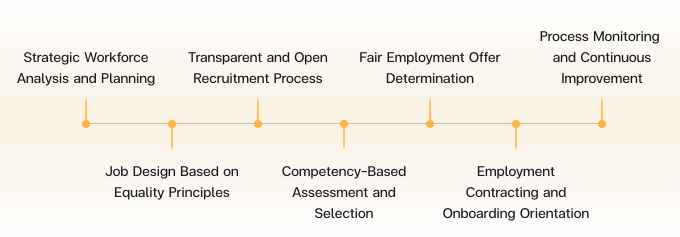
The Company establishes an integrated human resource management framework covering the entire employment lifecycle, from recruitment, development and training, and performance management to occupational health and safety, as well as employee engagement and motivation. The framework is guided by human rights principles and international labor standards to create shared value among the organization, employees, and society, under the following key approaches:
- Recruitment and selection are based on fairness, transparency, and non-discrimination, considering knowledge, competencies, skills, experience, and job suitability.
- Priority is given to local hiring to support the local economy and improve the quality of life of surrounding communities.
- Promote the employment and skills development of persons with disabilities, while providing an appropriate and safe working environment.
- The Company monitors and analyzes the new hire rate and turnover rate to manage labor risks and strengthen employee retention, thereby supporting effective human resource planning and workforce stability.
- Based on fairness, appropriateness, and competitiveness, referencing compensation benchmarking data within the same industry.
- Provide comprehensive welfare covering health, financial security, and livelihood, such as provident fund, life/health/accident insurance, scholarships, and other benefits.
- Consider employee benefits based on 10 key criteria (e.g., fairness, well-being, financial security, work-life balance, and linkage to performance outcomes), while also providing opportunities for employees to share feedback.
- Establish maternity leave and childcare leave practices in accordance with legal requirements and international standards, without affecting job security or career progression.
- The Company tracks the rate of return to work after leave expiration and employee retention rate to evaluate the effectiveness of its policies.
- The Company conducts annual performance evaluations for both executives and employees based on KPIs to improve work processes, enhance workforce capabilities, support career progression, and promote motivation through a transparent and fair system.
- Create a non-discriminatory work environment free from discrimination based on gender, race, religion, or other differences.
- Establish a Corporate Social Responsibility (CSR) policy covering human rights principles for stakeholders, along with activities that promote collaboration among personnel across diverse locations.
- Apply flexible working arrangements (Hybrid Working, Work from Home) as appropriate, along with recreational activities, skills development programs, and mental health support initiatives.
- Design a structured job architecture and career progression framework, define required competencies at each level under principles of equity and transparency, and integrate it with Individual Development Plans (IDP), Performance Management, and Succession Planning.
- Provide a safe and hygienic working environment in compliance with ISO 45001 standards to reduce risks associated with working with chemicals and machinery.
- Integrate occupational health and safety, compensation and benefits, human resource development, and work-life balance into the management system.
- Promote an open working environment that encourages the exchange of views and collaboration, supported by structured mechanisms for receiving and responding to feedback.
- Use Employee Engagement Indicators linked with turnover and retention rates to identify development opportunities within the organization.
- Conduct a biennial survey, with a target employee satisfaction level of no less than 85% (latest survey conducted in 2024, with the next reporting scheduled for 2027).
- Ensure independence, transparency, and confidentiality of data, and utilize the results to improve policies and human capital management practices.
Training and Development
The Company systematically and continuously develops employee capabilities as a key mechanism to enhance competitiveness, aiming to elevate essential knowledge, skills, and competencies across all dimensions, including professional expertise, technology, occupational health and safety, and behavioral skills. This is achieved through internal and external training programs, on-the-job learning, knowledge transfer from experts, and individualized development initiatives, with clearly defined short-, medium-, and long-term plans and objectives. The key approaches are as follows:
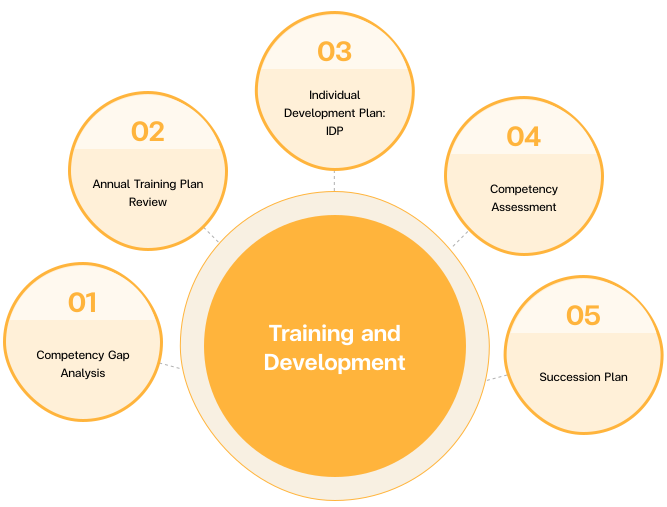
- Utilized as a strategic tool for human resource development planning by comparing current competencies with required competencies under the Professional Level framework.
- Systematically identify strengths and skill gaps for each position to enable targeted development and promote equitable development opportunities.
- Analyze and consolidate training needs from the Training Road Map (TRM), prioritizing them based on competency gaps, and covering both core competencies and leadership competencies.
- Complete the annual training plan by December of each year, categorized into two levels: the Executive Development Plan (EDP) and the training plan for employees below C-Level.
- Review and update the plan every three months to ensure alignment with business needs and changing circumstances.
- It serves as a tool to enhance employee capabilities in a targeted manner aligned with organizational objectives, helping to reduce skill gaps, improve competitiveness, and promote equal access to development opportunities.
- Define a variety of development approaches, such as on-the-job training, job rotation, and coaching/mentoring.
- Assess employee potential against organizational competency requirements by position and strategy through four methods: self-assessment, supervisor/manager assessment, behavioral observation in real situations, and tests or simulations.
- Use the assessment results to develop training plans, enhance employee potential, and prepare for career advancement.
- Prepare suitable personnel in advance for key or specialized positions to mitigate risks arising from retirement, resignation, or job transitions.
Stakeholders Directly Impacted