
Responsible Supply Chain Management





Manage the supply chain transparently and fairly, with due consideration for ESG responsibilities.
Develop and communicate a Supplier Code of Conduct to enhance standards for responsible business practices with suppliers.
Systematically integrate ESG criteria into supplier selection, assessment, and performance monitoring processes.
Expand ESG assessments to cover 100% of key suppliers by 2029, with follow-up actions to address identified risk issues.
Study and develop an approach to Human Rights Due Diligence (HRDD) for suppliers and the supply chain.
Improve the efficiency of raw material procurement and cost management to support the target of achieving a Gross Profit Margin of more than 15% by 2029.
Began applying ESG risk assessment criteria to all new suppliers.
Conducted ESG assessments and analyses of supplier performance, including on-site visits to supplier facilities.
Initiated the development of a Supplier Code of Conduct.
Began studying and developing a Human Rights Due Diligence (HRDD) approach.
Categorized suppliers by raw material and product groups, including additives, base oils, and packaging materials, to support supplier risk management and prioritization.
Assessed key new suppliers through ESG evaluation, comprising 5 additive suppliers, 7 base oil suppliers, and 5 packaging suppliers.
Monitored raw material price trends and supply volumes while optimizing procurement processes to align with actual demand.
Began implementing technology-driven inventory management practices to enhance inventory control and stock management efficiency.
Challenges and Opportunities
Challenges
The Company must manage its supply chain within an increasingly complex business environment, including raw material price volatility, supply continuity, product quality, regulatory compliance, and growing stakeholder expectations regarding environmental, social, governance (ESG), and human rights performance.
In addition, extending ESG practices across suppliers and contractors requires continuous communication, assessment, monitoring, and supplier capability development. These efforts are essential to ensuring consistent standards throughout the supply chain and effectively mitigating risks that could impact the business.
Opportunities
Responsible supply chain management strengthens raw material security, mitigates risks related to product quality, delivery performance, costs, and corporate reputation, and enhances confidence among customers, shareholders, investors, and other stakeholders.
At the same time, ESG supplier assessments, the development of a Supplier Code of Conduct, and the adoption of technology in raw material inventory management help improve operational efficiency, foster long-term collaboration with suppliers, and support sustainable growth across the value chain.
Management Approach and Value Creation
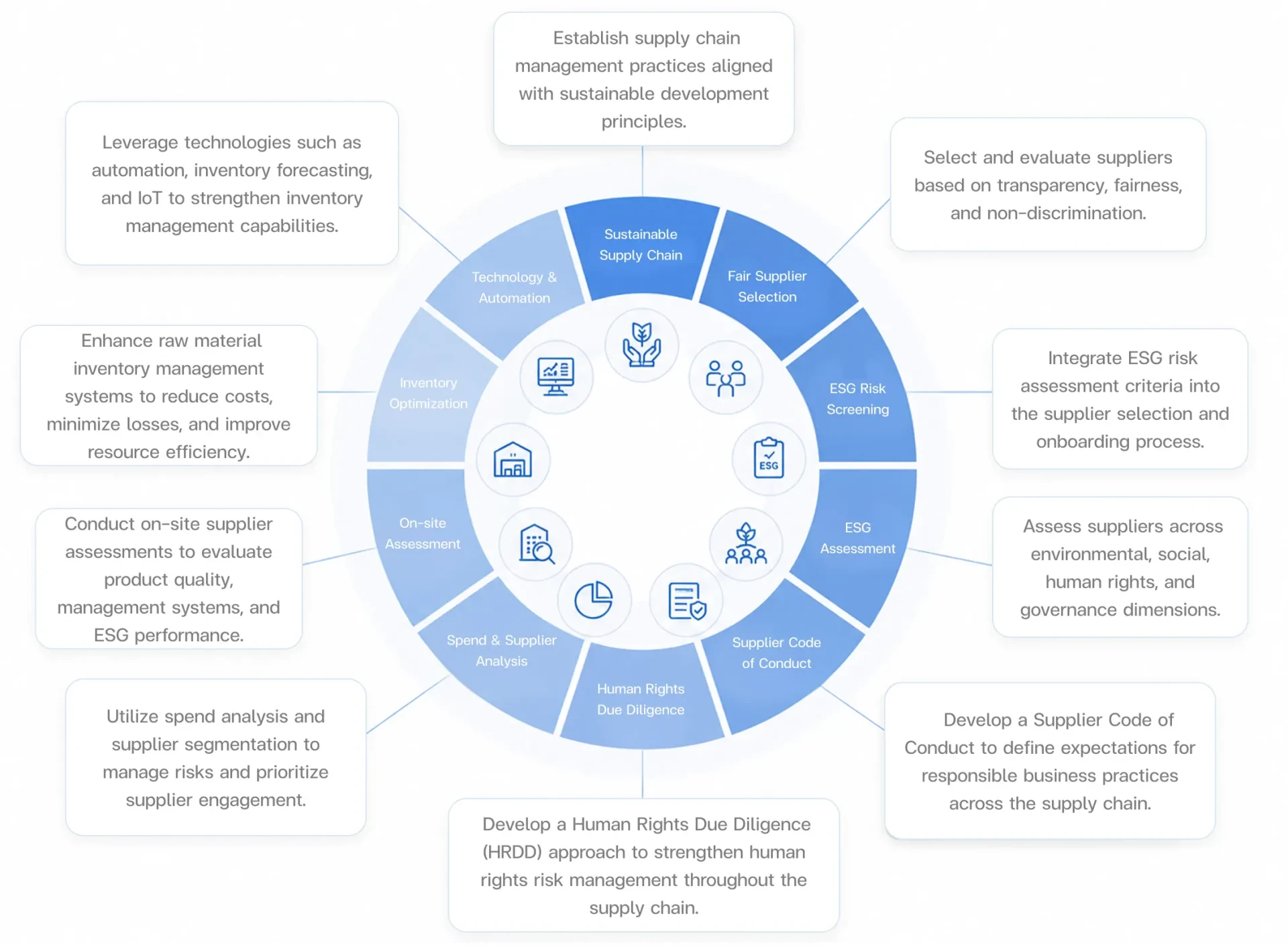
- Establish supply chain management practices aligned with sustainable development principles.
- Select and evaluate suppliers based on transparency, fairness, and non-discrimination.
- Integrate ESG risk assessment criteria into the supplier selection and onboarding process.
- Assess suppliers across environmental, social, human rights, and governance dimensions.
- Develop a Supplier Code of Conduct to define expectations for responsible business practices across the supply chain.
- Develop a Human Rights Due Diligence (HRDD) approach to strengthen human rights risk management throughout the supply chain.
- Utilize spend analysis and supplier segmentation to manage risks and prioritize supplier engagement.
- Conduct on-site supplier assessments to evaluate product quality, management systems, and ESG performance.
- Enhance raw material inventory management systems to reduce costs, minimize losses, and improve resource efficiency.
- Leverage technologies such as automation, inventory forecasting, and IoT to strengthen inventory management capabilities.
Stakeholders Directly Impacted