Economic Performance


Maintain revenue and profit growth in line with annual business plan targets, while strengthening competitiveness and supporting long-term growth.
Annually monitor and transparently disclose the economic value generated and distributed to stakeholders in an appropriate manner.
Deliver appropriate returns to shareholders in accordance with the dividend payment policy, while continuing to invest in future growth.
Promote employment security by providing employees with appropriate compensation and benefits, as well as continuous opportunities for professional and capability development.
Ensure that 100% of key suppliers undergo ESG assessment and due diligence by 2029 to promote a transparent and responsible supply chain.
Consider investments in projects that meet an average return on investment threshold of at least 12%, with cumulative investment value of no less than THB 1 billion by 2029.
Economic value distributed to stakeholders totaled approximately THB 2,145.5 million.
Dividend payments to shareholders amounted to THB 322.0 million.
Employee compensation and benefits totaled THB 646.4 million the highest level in the past five years.
Payments to suppliers and contractors amounted to THB 194.9 million.
Payments to government agencies, fees, and taxes amounted to THB 707.3 million, including income tax of THB 180.5 million.
Social investment totaled THB 7.8 million.
Environmental investment totaled THB 5.5 million.
Finance and operating costs amounted to THB 81.2 million, decreasing from THB 95.0 million in 2024.
Challenges and Opportunities
Challenges
The Company operates in an economic and industrial context characterized by volatility in raw material costs, intense market competition, evolving stakeholder expectations, and increasingly significant sustainability trends. As a result, the Company must manage financial performance prudently alongside cost control, risk management, maintaining competitiveness, and ensuring a balanced distribution of economic value to stakeholders.
Another key challenge is achieving long-term growth amid rapid changes in technology, consumer behavior, and the direction of the green industry. This requires the Company to continuously develop innovation, high value-added products, and new business opportunities that can generate economic returns while reducing social and environmental impacts.
Opportunities
Sustainable economic value creation provides opportunities for the Company to strengthen confidence among shareholders, investors, employees, suppliers, government agencies, communities, and society through fair, transparent, and verifiable distribution of economic benefits.
In addition, investment in innovation, technology, high value-added products, environmentally friendly products, circular economy initiatives, and future-oriented businesses—such as EV fluids, bio-based specialty products, re-refined base oil, food-grade lubricants, and immersion coolants—enhances business opportunities, expands revenue streams, reduces dependency on traditional business lines, and supports the Company’s long-term sustainable growth.
Management Approach and Value Creation
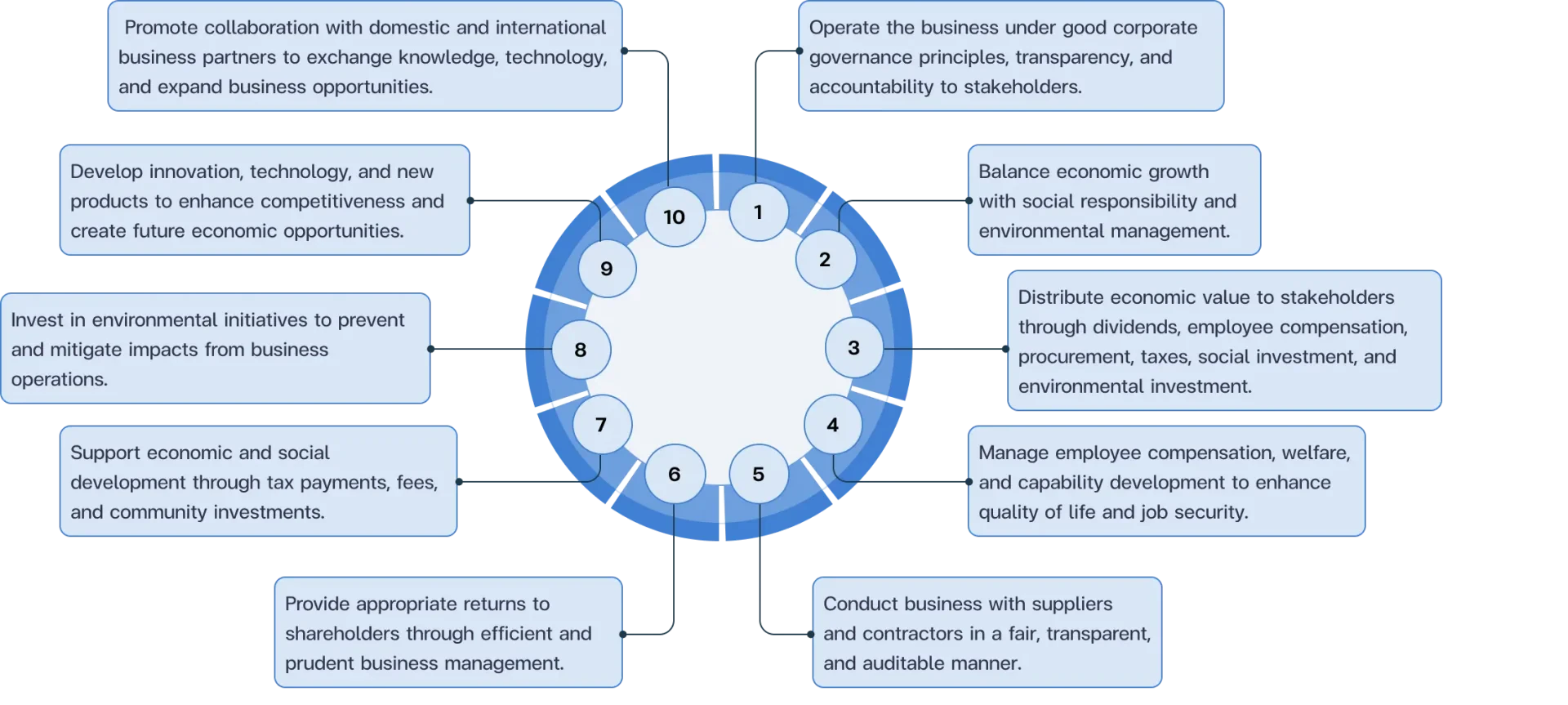
- Operate the business under good corporate governance principles, transparency, and accountability to stakeholders.
- Balance economic growth with social responsibility and environmental management.
- Distribute economic value to stakeholders through dividends, employee compensation, procurement, taxes, social investment, and environmental investment.
- Manage employee compensation, welfare, and capability development to enhance quality of life and job security.
- Conduct business with suppliers and contractors in a fair, transparent, and auditable manner.
- Provide appropriate returns to shareholders through efficient and prudent business management.
- Support economic and social development through tax payments, fees, and community investments.
- Invest in environmental initiatives to prevent and mitigate impacts from business operations.
- Develop innovation, technology, and new products to enhance competitiveness and create future economic opportunities.
- Promote collaboration with domestic and international business partners to exchange knowledge, technology, and expand business opportunities.
Stakeholders Directly Impacted