
Tax Management



Comply with tax laws and regulations accurately, transparently, and comprehensively.
Manage tax risks in alignment with the enterprise risk management and internal control systems.
Prevent tax disputes and minimize risks arising from non-compliance with tax laws and regulations.
Disclose tax information in a transparent, complete, and reliable manner.
Promote tax governance in accordance with good corporate governance principles and responsible business practices.
Continued to fulfill tax payment obligations and comply with applicable tax requirements accurately and consistently.
Monitored and assessed tax risks as part of the Enterprise Risk Management (ERM) framework.
Regularly reviewed relevant tax laws and regulatory requirements.
Utilized BOI tax incentives in compliance with applicable legal requirements.
No significant tax disputes were identified.
Recorded income tax expenses of THB 180.42 million, increasing from THB 169.39 million in 2024.
Maintained the corporate income tax rate at 20% in accordance with legal requirements.
Challenges and Opportunities
Challenges
The Company operates under tax laws, regulations, and requirements that are continuously evolving. As a result, it must continuously monitor, analyze, and update its operational practices to ensure compliance with applicable requirements. In addition, financial data management, tax calculation, and disclosure processes must be accurate, transparent, and auditable in order to reduce the risk of errors, tax disputes, and reputational impact on the organization.
Opportunities
Efficient tax management strengthens financial stability, reduces legal risks, and builds trust among shareholders, investors, regulators, business partners, and all stakeholders. It also reflects corporate responsibility toward the economy and society through accurate, transparent, and fair tax compliance, leading to the organization’s sustainable growth.

Management Approach and Value Creation
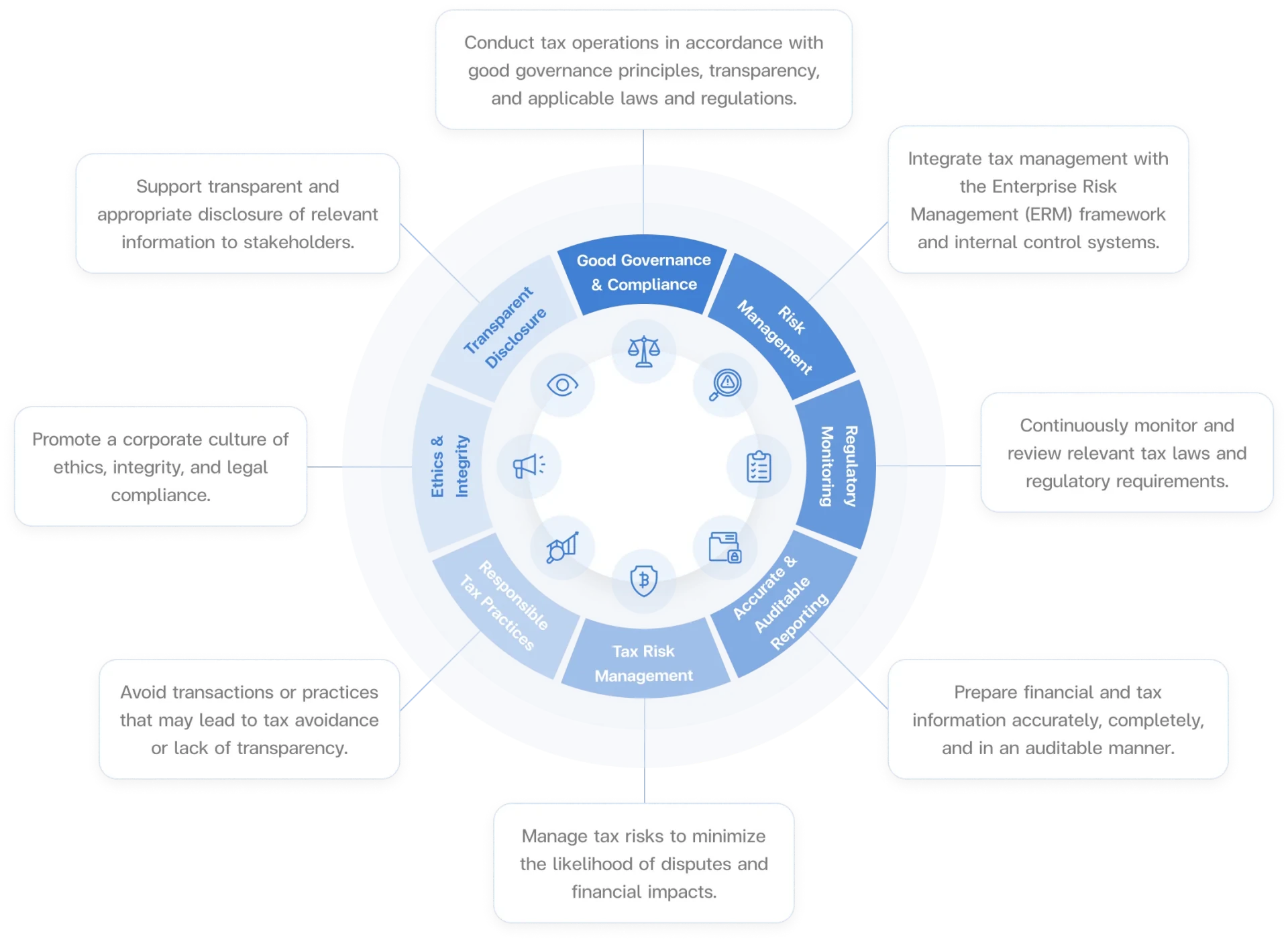
- Conduct tax operations in accordance with good governance principles, transparency, and applicable laws and regulations.
- Integrate tax management with the Enterprise Risk Management (ERM) framework and internal control systems.
- Continuously monitor and review relevant tax laws and regulatory requirements.
- Prepare financial and tax information accurately, completely, and in an auditable manner.
- Manage tax risks to minimize the likelihood of disputes and financial impacts.
- Avoid transactions or practices that may lead to tax avoidance or lack of transparency.
- Promote a corporate culture of ethics, integrity, and legal compliance.
- Support transparent and appropriate disclosure of relevant information to stakeholders.
Stakeholders Directly Impacted