


Materiality Assessment and the Definition of Impact on Stakeholders
Materiality Assessment
P.S.P. Specialties Public Company Limited (“the Company”) places importance on assessing and prioritizing sustainability issues (Material Topics) as a key mechanism for defining the organization’s ESG direction, strategy, targets, and operational approaches in alignment with its business context, stakeholder expectations, as well as risks and opportunities that may affect long-term sustainable growth.
The Company conducts its materiality assessment in accordance with the GRI Standards 2021, particularly GRI 3: Material Topics, which focuses on the organization’s impacts on the economy, environment, and society, including human rights (impact materiality), together with the degree of influence each issue has on stakeholder and investor decision-making. This ensures that the assessment reflects both sustainability impact and strategic risk dimensions in a comprehensive manner, consistent with the FTSE Russell approach that emphasizes ESG issues material to business performance and value creation.
PSP Materiality Determination Process
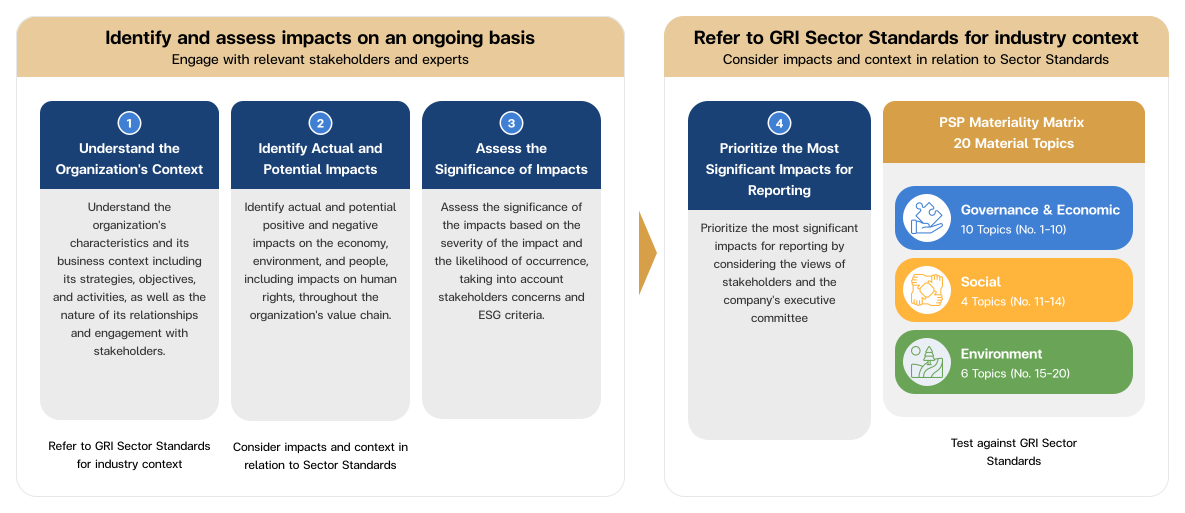
In 2023, PSP began identifying and prioritizing material sustainability topics as the first step, and this process is conducted annually in accordance with the GRI 3: Material Topics 2021 guideline as part of alignment with the GRI Standards.
Note:
- The process in steps 3 and 4 is an iterative and continuous process. Step 4 is the determination of material topics for reporting based on the assessment results.
- Material Topics 2021 (Figure 2): Guidelines for Defining Report Content, PSP
Step 1 Understand the organization's context
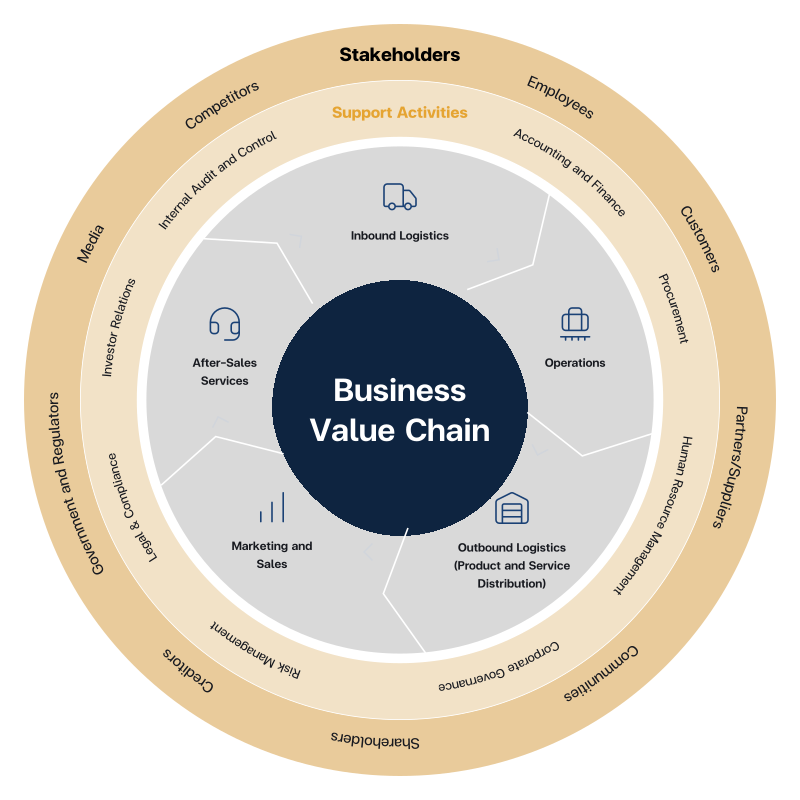
A high-level overview of business activities and business relationships (including suppliers and the upstream and downstream value chain) is prepared. Stakeholder analysis and the sustainability context in which the organization operates are conducted by considering the Company’s vision and mission, business model, industry characteristics, geographical location, as well as economic, environmental, and human rights challenges. This also includes applicable laws and international frameworks such as the ILO, OECD Guidelines, UNGPs, and the Paris Agreement. This step establishes a foundational dataset for identifying impacts and relevant stakeholder groups comprehensively, including indirect stakeholders such as supply chain workers and distant communities with no direct relationship to the Company.
Primary Activities — 5 Areas

Inbound Logistics (Supply Management)

Operations

Outbound Logistics (Distribution and Logistics):

Marketing and Sales

Customer Services
Support activities
The functions supporting all primary activities include


Step 2: Identification of Actual and Potential Impacts
Identify the organization’s impacts on the economy, environment, and people, including both positive and negative impacts in the short and long term, across all business activities and relationships. A variety of sources are used, such as impact assessments, legal compliance reviews, enterprise risk management (ERM) systems, grievance mechanisms, and consultations with stakeholders and experts. If resources are limited, negative impacts should be prioritized first. The Company analyzes the level of its involvement in negative impacts in three categories: cause, contribute, and directly linked through business relationships. These classifications determine the organization’s responsibilities in managing and remediating such impacts.
Step 3: Assessing the Significance of Impacts
Assess the significance of each impact in order to prioritize them, using both quantitative and qualitative analysis. For negative impacts, significance is determined based on “severity,” which includes scale, scope, and irremediable character, combined with the “likelihood” of occurrence for potential impacts. For positive impacts, significance is assessed based on the scale and scope of benefits. For human rights impacts, severity is always given greater weight than likelihood, regardless of probability. The assessment must compare impacts across the organization to determine relative materiality. This step may be integrated with the Enterprise Risk Management (ERM) system, provided that the system evaluates external impacts alongside risks to the organization.
Step 4: Prioritizing the Most Significant Impacts for Reporting
Rank impacts from highest to lowest significance and group related impacts into “Material Topics.” A defined threshold is established to determine which topics are considered material for reporting purposes. The Company then reviews alignment with relevant issues in the GRI Sector Standards, as well as feedback from experts and data users, before presenting the results for approval by the Board of Directors or senior management.
The results of the materiality assessment are used as a baseline for defining policies, targets, indicators, and operational plans for each business unit. They also serve as a framework for sustainability reporting and stakeholder communication. This process is reviewed annually and presented to the Board of Directors and relevant executive management for approval, ensuring that the identified material topics continue to reflect evolving business conditions and external contexts.
PSP Materiality Matrix
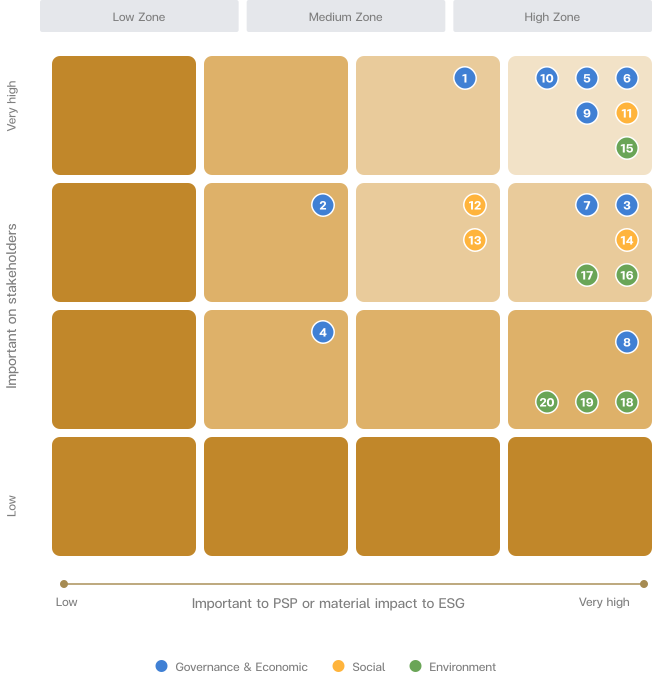
Governance & Economic
- Corporate Governance and Business Ethics
- Anti-Corruption
- Risk Management & Business Continuity Management
- Conflict and Security
- Business Development and Resilience
- Innovation
- Process Improvement
- Tax Management
- Procurement Practices & Supplier management
- Customer and Product Stewardship
Social
- Occupational Health and Safety
- Employee Management
- Employee Development
- Corporate Philanthropy
Environment
- GHG emissions
- Energy Management
- Water Management and Emissions
- Waste Management
- Biodiversity
- ESG Compliance
Impacts on Stakeholders
P.S.P. Specialties Public Company Limited (“the Company”) places importance on stakeholder engagement as a key mechanism for obtaining insights into perspectives, expectations, concerns, and suggestions from all parties related to its business operations. The Company recognizes that maintaining strong relationships and continuous communication with each stakeholder group is essential to supporting risk management, business strategy development, operational enhancement, and long-term sustainable growth.
Accordingly, the Company has established a systematic stakeholder management framework to identify, categorize, and prioritize groups that are directly and indirectly associated with its business operations across the entire value chain, including upstream, midstream, and downstream activities. This framework is linked to potential risks, impacts, and opportunities across economic, social, environmental, and governance dimensions.
In 2025, the Company continues to classify its stakeholders into nine main groups: employees, customers, suppliers, communities, shareholders, creditors, government agencies and state enterprises, media, and business competitors. These groups are considered materially relevant to the Company’s operations across all dimensions.
To ensure effective engagement, the Company has designed communication channels and participation mechanisms tailored to each stakeholder group, including direct meetings, surveys, executive–employee meetings, shareholder meetings, analyst meetings, customer and community engagement activities, online communication platforms, emails, and various complaint and feedback channels. These enable the Company to capture comprehensive feedback from all stakeholders.
The information and feedback received are analyzed and used as inputs for management decision-making, including the development of corporate strategy, product and service improvement, operational efficiency enhancement, and the determination of key sustainability issues aligned with stakeholder expectations and the Company’s growth direction.
Stakeholder Engagement Approach of the Company
Engagement Channels
- Executive–Employee Town Hall meetings
- Monthly employee meetings
- Communication via online platforms, intranet, and email
- Welfare Committee meetings
- Annual employee engagement survey
- Establishment of grievance and complaint channels
Stakeholder Issues
- Business direction
- Company performance results
- Business ethics
- Employee quality of life
- Fair compensation, welfare, and benefits
- Good working environment
- Employee capability development
- Equal treatment and non-discrimination
Relevant Sustainable Development Issues
- Corporate Governance
- Business Ethics
- Anti-Corruption
- Innovation and Product Development
- Employee Care
- Human Resource Development
- Occupational Health and Safety
- Human Rights
Engagement Channels
- Annual customer satisfaction survey
- Customer relations and marketing activities
- Direct meetings and consultations with customers
- Online communication and email channels
Stakeholder Issues
- Risk and crisis management
- After-sales service
- Customer relationship management
- Environmental management
- Customer complaint handling
- Protection of customer confidential information
- Equal treatment and non-discrimination
Relevant Sustainable Development Issues
- Customer and Product Responsibility
- Innovation and Product Development
- Greenhouse Gas Emissions
- Environmental Management (water, energy, and waste)
- Legal Compliance
- Human Rights
Engagement Channels
- Online communication and email channels
- Direct meetings and consultations
- Feedback and grievance channels
Stakeholder Issues
- Good Corporate Governance
- Business Ethics
- Fairness in Business Practices
- Transparent and Fair Procurement Processes
- Protection of Suppliers’ Confidential Information
- Equal Treatment and Non-Discrimination
Relevant Sustainable Development Issues
- Supply Chain Management
- Corporate Governance
- Anti-Corruption
- Human Rights
- Occupational Health and Safety
- Legal Compliance
- Human Rights
Engagement Channels
- Community engagement activities
- Online communication and email channels
- Other communication channels for receiving suggestions or complaints
Stakeholder Issues
- Good relationships with communities
- Compliance with social and environmental laws
- Improving quality of life in communities and society
- Building networks for collaborative community and social development
Relevant Sustainable Development Issues
- Community participation
- Social activities
- Legal compliance
Engagement Channels
- Subsidiary and joint venture board meetings
- Presentation of investment information to the Stock Exchange of Thailand
- Company performance briefing meetings
- Online communication and email channels
Stakeholder Issues
- Fair and equal treatment of shareholders
- Accurate, complete, and timely disclosure of information
- Good corporate governance, including anti-corruption and anti-bribery practices
- Strong business performance and sustainable business growth
- Effective business risk management
Relevant Sustainable Development Issues
- Corporate Governance
- Economic Value Creation
- Risk Management and Business Continuity Management
- Legal Compliance
Engagement Channels
- Analyst meetings
- Lender meetings
- Site visits
- Online communication and email channels
Stakeholder Issues
- Compliance with loan and bond covenants
- Risk management
Relevant Sustainable Development Issues
- Business Ethics
- Economic Value Creation
- Risk Management and Business Continuity Management
Engagement Channels
- Participation in government-supported projects
- Participation in government working groups
- Site visits
- Information disclosure or reporting as required
Stakeholder Issues
- Compliance with applicable laws and regulations
- Transparent disclosure of information
- Economic value creation
Relevant Sustainable Development Issues
- Community participation
- Social activities
- Legal compliance
- Corporate governance
- Anti-corruption
- Occupational health and safety
Engagement Channels
- Press releases / press conferences
- Special interviews upon media request
- Disclosure of information or reports as required
Stakeholder Issues
- Access to complete, accurate, and timely information
- Disclosure of truthful information
- Good treatment of media representatives
Relevant Sustainable Development Issues
- Corporate Governance
- Anti-Corruption
- Community Participation
- Social Activities
Engagement Channels
- Industry association meetings and collaborative forums
- Network collaboration in accordance with government policies
Stakeholder Issues
- Fair competition
- Legal compliance
Relevant Sustainable Development Issues
- Corporate Governance
- Challenges and Opportunities
- Business Ethics
- Anti-Corruption
The Company believes that continuous and systematic stakeholder engagement is a fundamental foundation for building trust, strengthening relationships, and supporting sustainable and stable business growth. Feedback from all stakeholder groups is therefore used as an integral input for organizational development, operational improvement, and the continuous creation of shared value.
