Sustainability Strategy and Commitment
Supporting the UN Sustainable Development Goals (SDGs)
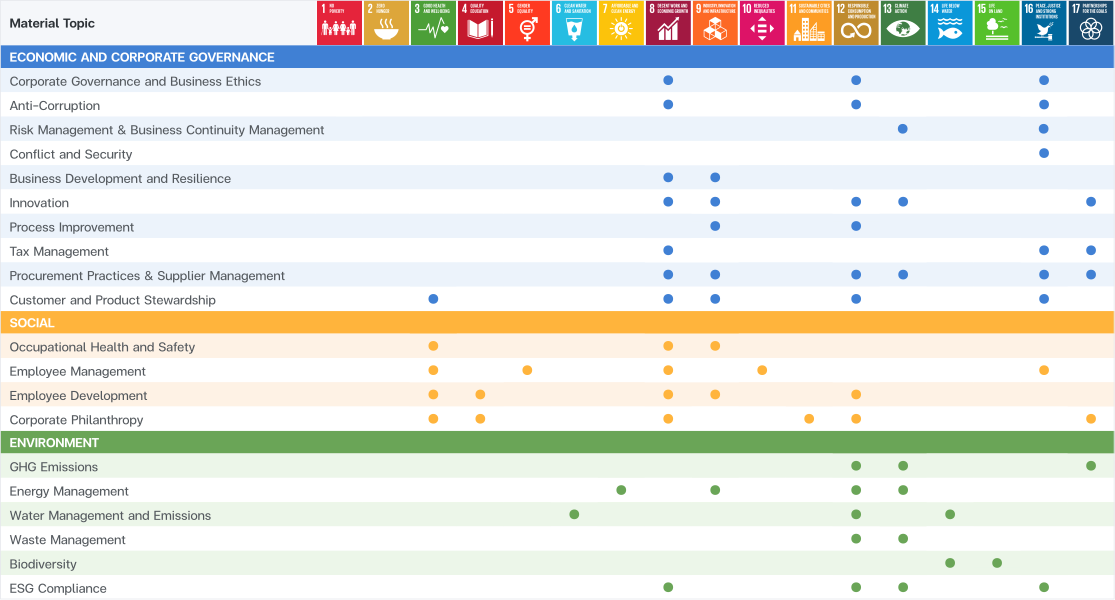
P.S.P. Specialties Public Company Limited integrates the United Nations Sustainable Development Goals (UN SDGs) into its corporate strategy and business operations. The Company has identified and prioritized 20 material sustainability topics across three key dimensions: economic and corporate governance, social, and environmental. Each material topic is aligned with the relevant SDGs to demonstrate the Company’s tangible contribution to creating shared value for the economy, society, and the environment.
Governance & Economic
This dimension encompasses corporate governance and business ethics, anti-corruption, risk management and business continuity, information security, transparent tax management, responsible procurement and value chain management, as well as business development, innovation, and products and services stewardship. These efforts aim to drive sustainable growth and strengthen stakeholder trust.
Supporting Topics under This Dimension
SDG 8 (Decent Work and Economic Growth) and SDG 16 (Peace, Justice and Strong Institutions) serve as the primary goals, supported by SDG 9 (Industry, Innovation and Infrastructure), SDG 12 (Responsible Consumption and Production), and SDG 17 (Partnerships for the Goals). Together, these goals reflect the Company’s commitment to conducting business transparently, upholding good governance, and achieving responsible growth throughout the value chain.

Social
This dimension encompasses employee management and capability development, occupational health and safety, and community engagement. These efforts are grounded in respect for human rights, fair labor practices, diversity, and equality, with the aim of enhancing quality of life and creating measurable social outcomes.

Supporting Topics under This Dimension
The topics under this dimension contribute to SDG 3 (Good Health and Well-being), SDG 4 (Quality Education), and SDG 5 (Gender Equality) through employee care and development. They also support SDG 8 (Decent Work and Economic Growth), SDG 10 (Reduced Inequalities), and SDG 11 (Sustainable Cities and Communities), SDG 16 (Peace, Justice and Strong Institutions), and SDG 17 (Partnerships for the Goals) through fair and inclusive employment practices, employee development, community engagement, and collaboration with stakeholders in communities surrounding the Company’s operations.

Environment
This dimension encompasses climate change and greenhouse gas management, efficient energy and water use, pollution control and waste management, biodiversity conservation, and compliance with ESG-related laws and requirements. These efforts aim to minimize environmental impacts arising from the Company’s operations, enhance resource efficiency, and advance the circular economy.

Supporting Topics under This Dimension
SDG 12 (Responsible Consumption and Production) and SDG 13 (Climate Action) serve as the primary goals, supported by SDG 6 (Clean Water and Sanitation), SDG 7 (Affordable and Clean Energy), SDG 14 (Life Below Water), SDG 15 (Life on Land), and SDG 16 (Peace, Justice and Strong Institutions). These goals are advanced through responsible resource and environmental management, together with compliance with ESG-related laws and requirements.

Sustainability Committee Structure
To enhance the effectiveness of the corporate sustainability management system, in 2024 the Company established a dedicated Sustainable Development Steering Committee and Working Team to systematically oversee sustainability issues and integrate ESG principles into the organization’s business strategy and operations. The structure consists of one Steering Committee and five specialized working teams, covering the economic, social, environmental, governance, and climate change dimensions.
Composition of the Committee and Working Teams
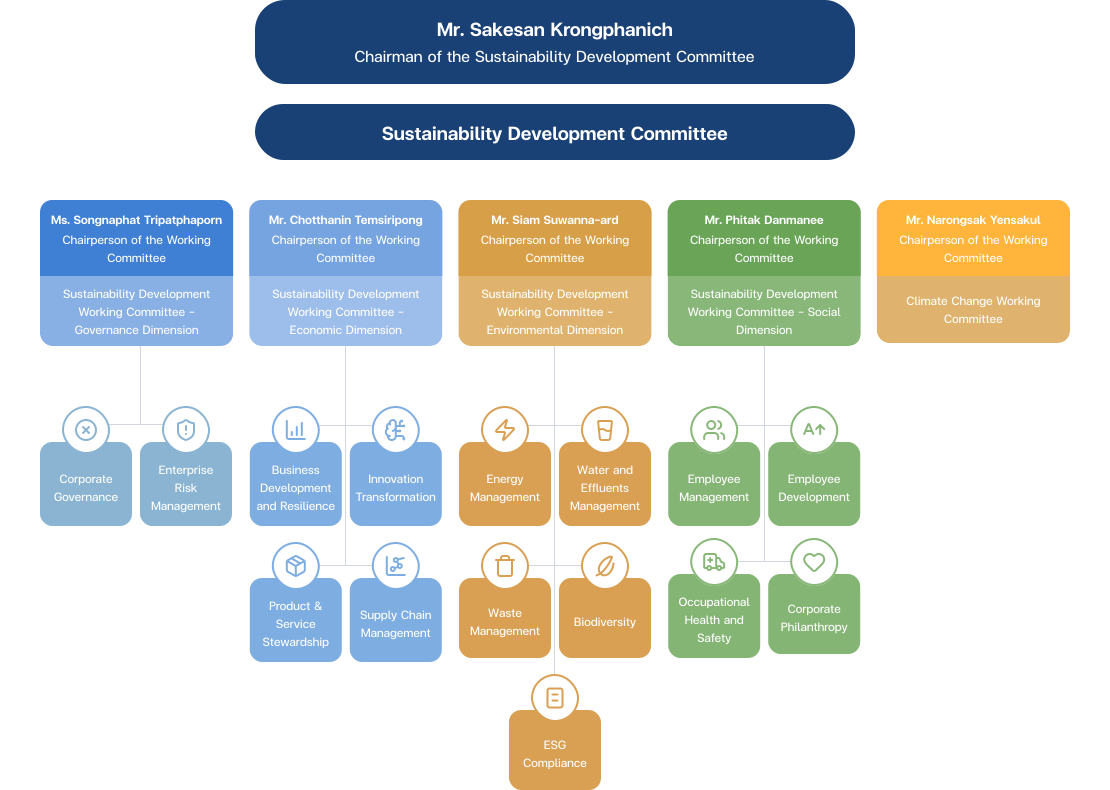
- The Sustainability Development Committee is chaired by Mr. Seksan Khrongphanich and consists of five members, each of whom serves as the chair of a working committee responsible for monitoring the performance of the respective specialized working committees.
| Working Committees | Chairperson of the Working Committee | Scope of Oversight Issues |
|---|---|---|
| Economic Dimension | Mr. Chotthanin Temsiripong | Business Development and Resilience, Innovation Transformation, Product & Service Stewardship, Supply Chain Management |
| Governance Dimension | Ms. Songnaphat Tripatphaporn | Corporate Governance, Enterprise Risk Management |
| Social Dimension | Mr. Phitak Danmanee | Employee Management, Occupational Health and Safety, Employee Development, Corporate Philanthropy |
| Environmental Dimension | Mr. Siam Suwanna-ard | Energy Management, Waste Management, Water and Effluents Management, Biodiversity, ESG Compliance |
| Climate Change | Mr. Narongsak Yensakul | Greenhouse gas management and climate change issues |
- The committee and working teams are appointed by the Chief Executive Officer. At least one member of the Board of Directors is designated as the Chairperson of the Sustainability Development Committee, and one Secretary is appointed. Members are required to have knowledge and understanding of the Company’s business and possess expertise in sustainability and risk management.
- The Chairperson of the Committee and Working Teams has a term of office of three years and may be reappointed upon completion of the term. Termination of office may occur due to completion of term, resignation, death, or resolution of the Board of Directors. In the event of a vacancy, the Sustainability Development Committee shall appoint a suitable person to serve as a replacement.
- The Committee and Working Teams shall meet at least twice a year and may convene additional meetings as necessary. Meeting agendas and supporting documents must be prepared in advance of each meeting. A quorum shall consist of no less than two-thirds of the total members.
- The Committee and Working Teams are required to report their performance results to the Board of Directors at least once a year, and to conduct annual performance evaluations and submit the results to the Board of Directors.
Scope of Authority and Responsibilities
- Supervise and provide guidance on corporate ESG strategies and sustainability policies at the organizational level.
- Monitor and evaluate ESG performance to ensure effective risk management across the Company.
- Promote stakeholder engagement and conduct materiality assessments on key sustainability issues.
- Prepare sustainability reports in accordance with the requirements of the Securities and Exchange Commission (SEC) and relevant authorities.
- Oversee sustainability disclosures through the annual report and sustainability report.
- Review and update the scope of authority and responsibilities at least once a year, and perform other duties as assigned by the Board of Directors.
Sustainable Development Steering Committee and Working Team
Sustainability Strategy, Framework, and Goals
PSP Specialties Public Company Limited (PSP) defines its sustainability policies and targets in alignment with its business direction and corporate strategy, under the Environmental, Social, and Governance (ESG) framework, together with support for the United Nations Sustainable Development Goals (UN SDGs). In 2023, the Company established its corporate sustainability framework to systematically drive operations across three strategic dimensions: Economic and Governance, Social, and Environmental. The Company aims to enhance its performance by 2027 and further advance toward long-term targets by 2029, covering 20 key sustainability issues identified in the organization’s Materiality Matrix.
Sustainability Strategy – 3 Dimensions


Economic Strategy (Business Development and Resilience)
Focuses on developing integrated lubrication technologies and products across the business value chain,
leveraging all business opportunities, and continuously adapting to risks to achieve sustainable and limitless growth.


Environmental Strategy (Value Consumption and Circular Economy)
Focuses on delivering product and service value based on
maximizing resource efficiency under circular economy principles, while promoting efficient and responsible resource utilization.


Social Strategy (People Development and Excellence)
Focuses on enhancing skills, knowledge, and organizational understanding
of human capital toward excellence, while fostering engagement with all stakeholder groups.
Sustainability Framework
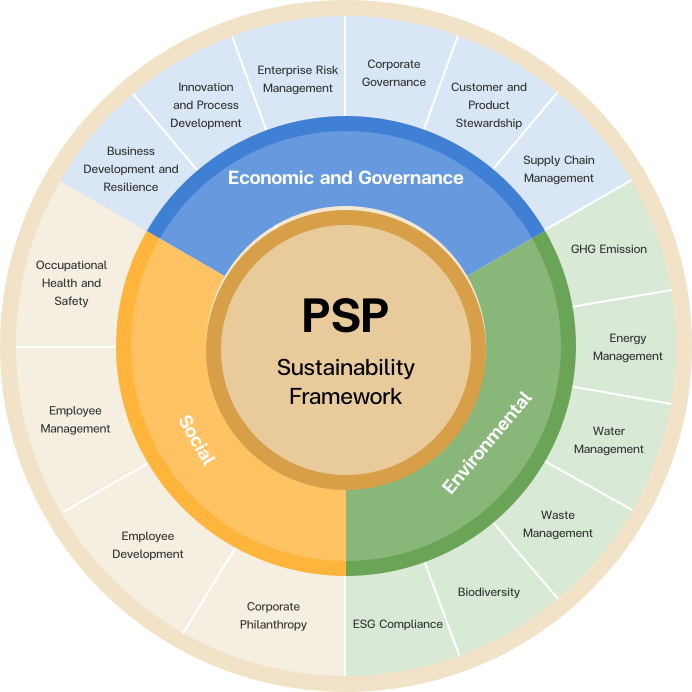
Economic and Governance Dimension (Business Development and Resilience)
- Business Development and Resilience: Creating business opportunities while adapting strategies to address enterprise-level risk factors.
- Innovation and Process Development: Researching, developing, and producing technologies and innovations for sustainable growth.
- Enterprise Risk Management: Managing risks across all dimensions to ensure business continuity.
- Corporate Governance: Building organizational values and culture in accordance with good corporate governance principles.
- Customer and Product Stewardship: Building trust and satisfaction in the delivery of products and services.
- Supply Chain Management: Managing the supply chain while developing capabilities and efficiency in collaboration with business partners.
Environmental Dimension (Value Consumption and Circular Economy)
- GHG Emission: Reducing greenhouse gas emissions across the entire business value chain.
- Energy Management: Improving production efficiency to reduce energy consumption through environmentally friendly technologies and renewable energy.
- Water Management: Enhancing wastewater treatment efficiency for sustainable water resource utilization.
- Waste Management: Reducing waste at source in accordance with the 3Rs principles and circular economy.
- Biodiversity: Enhancing biodiversity within company areas and surrounding communities.
- ESG Compliance: Governing and monitoring compliance with applicable laws across the value chain.
Social Dimension (People Development and Excellence)
- Occupational Health and Safety: Establishing safe work processes and service delivery with the highest level of safety, aiming toward zero accidents.
- Employee Management: Building a high-quality working environment that supports good quality of life.
- Employee Development: Promoting and supporting skill development to achieve maximum work efficiency.
- Corporate Philanthropy: Supporting community and social development initiatives.
Corporate Sustainability Targets (2024 - 2032)
Economic and Governance Dimension
Number of significant corporate governance complaints

CG Rating: 5-Star Level

Thai Private Sector Collective Action Against Corruption (Thai CAC) certification

ESG risk management covering

Conduct a Business Continuity Management (BCM) drill

Achieve an average return on investment of at least

Achieve a customer satisfaction rate of more than

significant customer complaints regarding products and services


Develop
Invest more than

Achieve a

Conduct ESG Due Diligence assessments covering

Achieve a gross profit margin from raw material inventory management of more than

Environmental Dimension
Reduce organizational energy consumption by

Waste to Landfill for industrial waste by 2029.

Reduce water consumption by
significant incidents of non-compliance with ESG-related laws and regulations

greenhouse gas emissions by 2050, while developing a greenhouse gas inventory and Carbon Footprint for Organization (CFO) reporting

Plant more than

Social Dimension
Provide employees with at least

Ensure

Achieve an employee engagement level of at least

Maintain the employee turnover rate at no more than

Establish Succession Plans for all

significant complaints related to human rights and equality

Implement an occupational health and safety management system covering all functions across the Company and its subsidiaries, and achieve

Invest in and develop local communities by supporting initiatives related to quality of life, health, the environment, youth safety, and income generation, with outcomes monitored and evaluated