Water and Pollution Management
Water Management
Reduce water consumption by 5% by 2029, compared with the 2023 baseline, while improving water-use efficiency, minimizing water losses, and continuously monitoring performance.
Pollution Management
Continuously control air emissions from emission sources to ensure compliance with applicable legal and regulatory standards.
Control operational noise levels to ensure compliance with applicable legal standards and environmental requirements.
Prevent and minimize impacts related to odor, noise, and air quality arising from operations, with a target of zero significant environmental complaints from local communities.
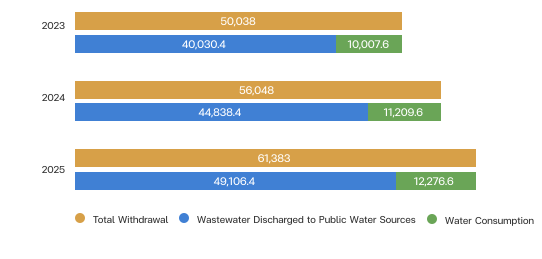
Total water withdrawal in 2025 was 61,383 cubic meters, showing a continuous increase from the previous year in line with the expansion of operational activities. This represents a challenge that requires close monitoring.
The primary water source is external supply (municipal water), with no use of surface water or groundwater.

Total water withdrawal in 2025
61,383 cubic meters
The wastewater treatment system effectively controls effluent quality and reduces risks to surrounding water bodies and ecosystems. Based on monthly effluent quality monitoring results under the 2025 EIA Monitoring Report, it was found that the treated wastewater consistently complies with applicable standards.
- All parameters remained within the standard limits throughout the year.
- The Barium parameter has been discontinued from analysis, as no products containing Barium are used in the production process.
The use of recycled water is promoted at PSP1 for suitable activities such as irrigation and cleaning, accounting for approximately 1% of total water consumption at the PSP1 site, in order to reduce reliance on freshwater sources.
Challenges and Opportunities
Water Management
Challenges
The first key challenge is the continuously increasing trend in water consumption. In 2025, the Company’s total water withdrawal reached 61,383 cubic meters, rising from 56,048 cubic meters in 2024 and 50,038 cubic meters in 2023. Wastewater discharge and net water consumption have also increased in the same direction, reflecting that the Company’s operations still rely significantly on water resources and are closely linked to business expansion. Achieving the target of a 5% reduction in water consumption by 2029 therefore requires in-depth analysis of the factors driving water use and the establishment of appropriate mitigation measures.
The second challenge is the Company’s reliance on a single water source, namely municipal or external water supply, with no use of surface water or groundwater. This creates the need for close management of water availability and cost risks. In addition, maintaining continuous compliance of wastewater quality with legal standards, as well as reducing water losses from leaks in pipelines and equipment, remains a challenge that requires systematic monitoring, tracking, and continuous improvement of water data management systems.
Opportunities
Improving water efficiency presents opportunities for the Company to reduce resource costs and long-term water-related risks through measures such as reducing water losses from leaks, regularly inspecting water supply systems and equipment, and analyzing water consumption data across office and production areas. These actions support both cost control and more efficient resource utilization.
In addition, the initial promotion of recycled water use at the PSP1 site for suitable activities (currently approximately 1% of total water consumption in the area) provides an opportunity to further expand water reuse practices in order to reduce reliance on external water sources in the future. Continuous compliance monitoring of wastewater quality against regulatory standards (through monthly EIA monitoring) also helps strengthen trust among communities and regulatory authorities while reducing legal compliance risks. Furthermore, promoting employee awareness and participation in water conservation creates an opportunity to foster a water-conscious culture, supporting long-term sustainable water management.
Pollution Management
Challenges
The first key challenge is that the Company’s operations cover factories, product warehouses, and a jetty, which involve multiple sources of pollution, including air emissions from stacks, noise from machinery and loading activities, and odor from product storage and transfer. Controlling all types of pollution across all areas therefore requires preventive measures, equipment maintenance, and systematic and continuous monitoring and inspection.
The second challenge is maintaining pollutant levels consistently within regulatory standards. In particular, nitrogen oxide (NOx) emissions at PSP1 in 2025 were recorded at 345 mg/m³ compared to the standard limit of 376 mg/m³. Although still compliant, the value is relatively close to the limit, requiring close monitoring and strict control of combustion efficiency and maintenance practices. In addition, issues related to noise and odor are highly dependent on community perception and may lead to complaints even when measured values are within standards. Therefore, achieving the “Zero Complaint” target requires close operational control and continuous communication with surrounding communities. Furthermore, strict and ongoing compliance with EIA conditions across multiple projects (Jetty 3, 4, and 5, and product storage facilities) remains essential.
Opportunities
In terms of opportunities, systematic pollution management under ISO 14001 and EIA frameworks enables the Company to enhance trust among communities, regulatory authorities, and other stakeholders, which is a key factor in maintaining the Social License to Operate and ensuring business continuity. The fact that all air emission parameters complied with regulatory standards in 2025 further demonstrates the effectiveness of source-level control measures and provides a strong foundation for maintaining long-term operational performance standards.
In addition, the development of monitoring systems and the use of environmental measurement data as a tool for trend analysis and operational improvement enable the Company to implement more effective preventive management, reducing the risk of abnormal incidents and complaints. Meanwhile, an effective grievance mechanism and appropriate response process help strengthen good relationships with surrounding communities. Furthermore, enhancing knowledge and awareness of pollution control among employees and contractors provides an opportunity to foster an environmentally responsible operational culture, supporting long-term sustainable business operations.
Management Approach and Value Creation
Water Management
The Company implements systematic water management covering the assessment and monitoring of water withdrawal from main water sources, analysis of water efficiency in office and production areas, inspection of water losses from leaks, promotion of water reduction measures, and development of water data systems to analyze trends and continuously improve efficiency. The approach is divided into two main parts as follows.
Management of Water Use and Water Sources
- Continuously monitor water withdrawal from main water sources, and assess trends and water-use efficiency in office and production areas to define improvement measures and reduce water consumption.
- Reduce water losses from leakage through regular inspection of plumbing systems and water-using equipment within operational areas.
- Promote knowledge and awareness of water conservation among employees to foster a culture of responsible water use.
- Promote the use of recycled water in suitable activities, such as watering plants and cleaning in selected factory areas, to reduce reliance on external water sources.
Wastewater Management in the Company’s Treatment System
- Control, operate, and continuously improve the wastewater treatment system to ensure effluent complies with applicable standards before discharge to external environments.
- Regularly monitor and analyze effluent quality against key parameters to assess the efficiency of the treatment system and minimize impacts on the environment and surrounding communities.
- Use wastewater analysis results as a tool for monitoring, reviewing, and continuously improving the efficiency of the wastewater treatment process.
- Systematically collect and report wastewater and effluent data to support performance evaluation, risk prevention, and the enhancement of wastewater management standards.
- Promote water conservation within the organization through awareness building, campaigns on responsible water use, reduction of system water losses, and consideration of water reuse initiatives.
Pollution Management
The Company implements systematic pollution management, focusing on controlling air quality, noise, and odor arising from operations at factories, product warehouses, and jetties. The approach is based on pollution prevention at source, compliance with applicable laws and regulatory requirements, and environmental impact prevention and monitoring measures in accordance with EIA reports for relevant projects. The management approach covers five key areas as follows.
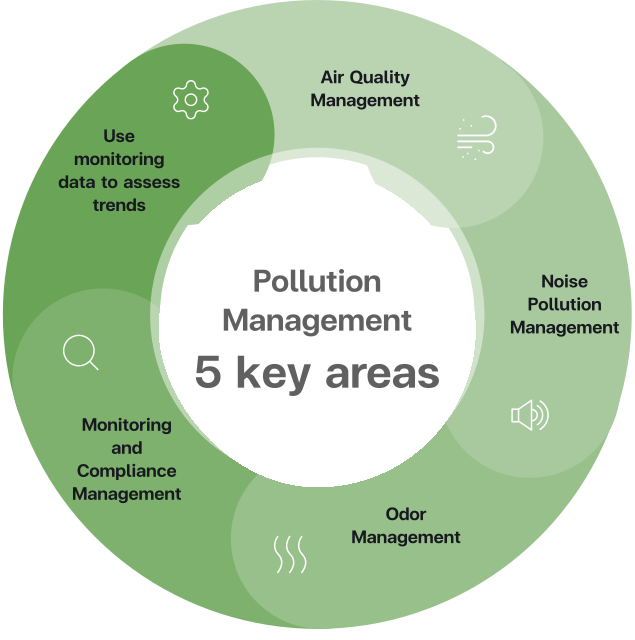
- Air Quality Management
- Control air emissions at the source, particularly from stacks and activities that may generate dust, smoke, or pollutants (such as SOx, NOx, and particulate matter).
- Maintain machinery, equipment, and systems in operational readiness, supported by preventive maintenance and operational control in accordance with defined conditions.
- Monitor stack air emissions periodically based on relevant parameters to track and evaluate the effectiveness of control measures.
- Noise Pollution Management
- Control noise from machinery, equipment, and loading activities at the source.
- Maintain equipment in proper condition and control operational practices.
- Monitor noise levels in accordance with regulatory requirements and EIA mitigation measures for jetty areas and related activities, to prevent impacts on employees and surrounding communities.
- Odor Management
- Prevent and reduce odor impacts from storage, handling, and operational activities in warehouse and jetty areas.
- Control operations in accordance with defined measures and ensure that site conditions and equipment are properly maintained and ready for use.
- Closely monitor complaints or observations from communities and stakeholders to ensure appropriate prevention and timely corrective actions.
- Monitoring and Compliance Management
- Monitor environmental quality in accordance with the planned schedule and frequency required by laws, regulatory requirements, and EIA mitigation measures.
- Covering stack emission monitoring, noise monitoring, and surveillance of impacts on the surrounding environment.
- ใช้ข้อมูลจากการตรวจติดตามในการประเมินแนวโน้ม ทบทวนประสิทธิภาพมาตรการ และปรับปรุงการดำเนินงานอย่างต่อเนื่อง
- Use monitoring data to assess trends, review the effectiveness of measures, and continuously improve operational performance.
- Complaint Management and Continuous Improvement
- Use complaint data together with monitoring results to assess risks and review pollution control measures.
- Continuously improve pollution management efficiency under the environmental management system framework and project requirements.
Stakeholders Directly Impacted
Water Management


Pollution Management